

When planning your financial future, five-year plans are an excellent tool for tracking both short-term and long-term goals, providing ample flexibility and time to make necessary adjustments. Since real estate is typically the largest investment you’ll make, it’s crucial to monitor the changes in equity growth within five-year periods, especially following the significant price fluctuations that occurred nationwide during the pandemic.
Enjoying our content? Subscribe to our free weekly newsletter to get real estate market insights, news, and reports straight to your inbox.
So exactly how much has housing affordability changed in the past five years? To find out, Zoocasa analyzed composite benchmark home prices in 19 Canadian cities from 2019 to 2024, sourced from the Canadian Real Estate Association.
How Have Prices Evolved in Canada's Top Markets Since 2019?
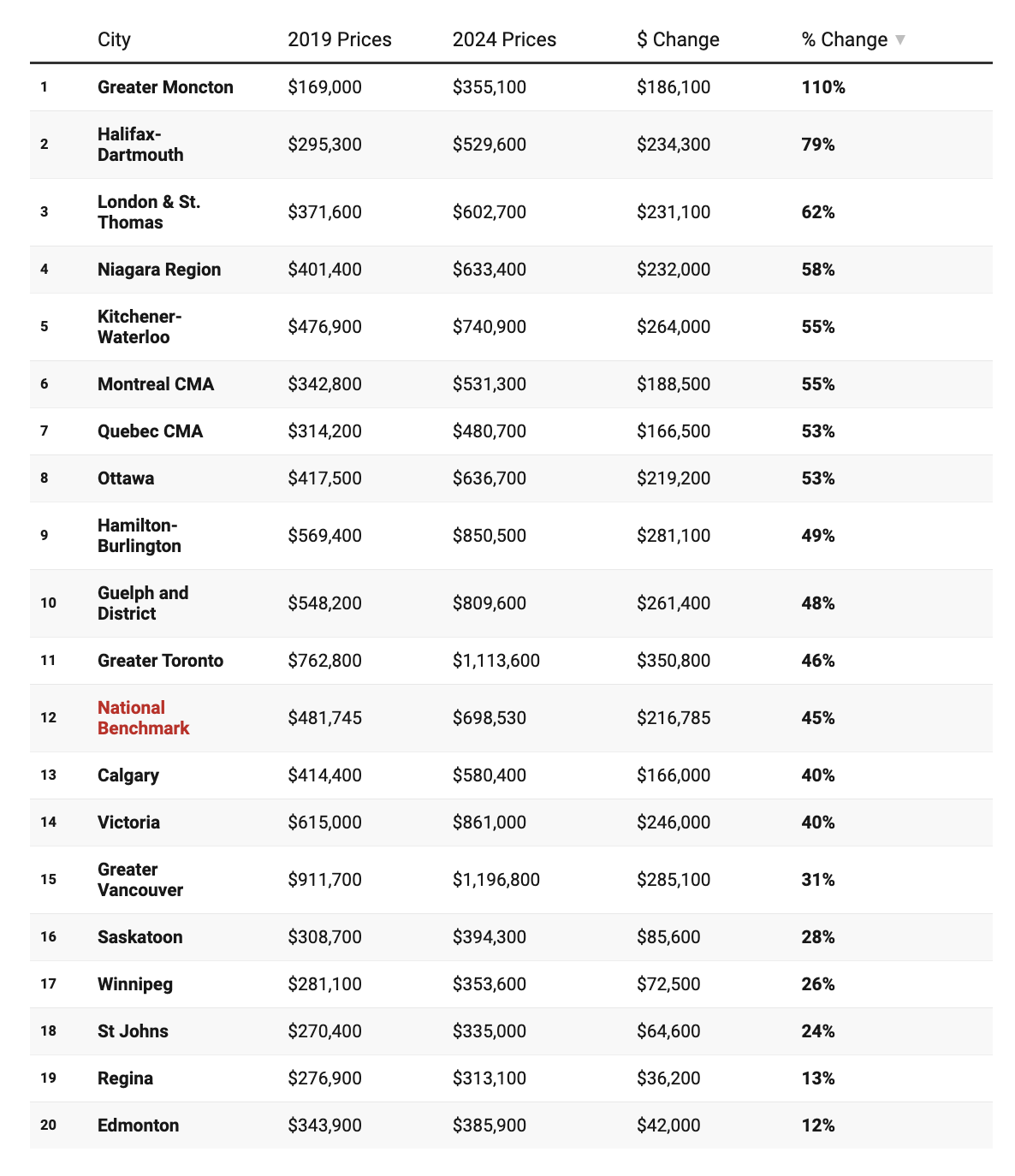
Data source: Zocasa*
Affordable Housing Analysis: Superior Returns on the East Coast
Over the past five years, real estate markets with notable affordability have consistently demonstrated the highest returns on investment.
Greater Moncton holds the leading position for affordable housing, with the average home price rising by 110%, from $169,000 in March 2019 to $355,100 in March 2024—a significant gain of $186,100. Following closely, the Halifax-Dartmouth area recorded the second-largest increase, with house prices surging 79% from $295,300 to $529,600, equalling a growth of $234,300.
Among the various markets analyzed, St John’s, Newfoundland showed the lowest five-year growth among the top performers, yet it still achieved a growth rate of 24%, increasing from $270,400 in March 2019 to $335,000 in March 2024.
An East Coast city topped our recent list of the best places to buy real estate in Canada in 2024.
Ontario Market Performance Since Spring 2019
Cities in Ontario have also experienced substantial growth. The London & St. Thomas, Niagara Region, Kitchener-Waterloo, and Ottawa all saw benchmark prices surpassing 50% since March 2019.
Read: Bought Your Toronto Condo 5 Years Ago? Here’s How Much Equity You’ve Built
Additionally, the Greater Toronto area, Guelph, and the Hamilton–Burlington region recorded growth rates slightly above the national benchmark, with home prices increasing from a whopping 46% to 49%.
Exploring Alberta’s Housing Market Trends
Calgary experienced a 40% increase in price change since March 2019, from $414,400 to $580,400. Edmonton experienced the least amount of growth in price changes of all markets analyzed for a 12.2 percent increase, from $343,900 to $385,900. Looking at Alberta’s price changes in the past five years is particularly noteworthy because of the increase in interprovincial migration seen in recent years.
Related: Here’s What First-Time Home Buyers Will Pay in Closing Costs in Alberta.
According to Statistics Canada, Alberta set a national record by gaining 55,107 people through interprovincial migration, mainly from Ontario and British Columbia, home to provinces that have some of the most expensive housing markets in the country. This trend suggests that Alberta is becoming an increasingly attractive destination for Canadians seeking affordability.
Are you planning your next move? Whether you’re planning to relocate or looking for a place close to home, we can help! Give us a call today to speak to a Realtor who can help make your homeownership dreams a reality.
Bottom Line
Canadian real estate markets have evolved significantly over the past five years, with the East Coast leading in affordability and returns, Ontario experiencing strong growth, and Alberta attracting more buyers due to interprovincial migration. Understanding these trends is key to making informed real estate decisions.

